Hacon J warns that the reasonable reader should not be regarded as an “anxious pedant”
Babek International Ltd v Iceland Foods Ltd [2025] EWHC 547 (IPEC)
https://www.bailii.org/ew/cases/EWHC/IPEC/2025/547.html
This case concerns a trade mark held by Babek International Ltd which they claimed had been infringed by Iceland Foods Ltd, who have in turn counterclaimed for invalidity. An application for summary judgment was made by Iceland, regarding their counterclaim for a declaration of invalidity. They argued that the trade mark did not meet the registration requirements in s.1(1) and s.3(1) of the Trade Marks Act 1994 and should be declared invalid under s.47(1). The parties were in agreement that the validity of the trade mark should be determined at this application which was heard by Hacon J.
Section 1(1) of the Trade Marks Act 1994 sets out that a trade mark must be represented in the register in a manner enabling the competent authorities and public to determine the clear and precise subject matter and must be capable of distinguishing goods of one undertaking from those of other undertakings. Section 3(1) confirms that signs that do not satisfy these requirements should not be registered and section 47(1) allows trade marks to be declared invalid where they are registered in breach of section 3.
The trade mark in issue consists of the image below with the description: "Gold oval with embossed BABEK writing. Colour Claimed: Gold, black."
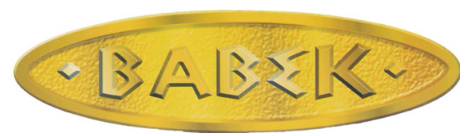
It was claimed by Iceland that the trade mark was invalid due to a lack of clarity and precision at the date of registration. Iceland argued that Babek's trade mark was ambiguous because it had been described as a figurative mark but the word "embossed" suggested that the sign was three dimensional. Hacon J held that the statement of the type of mark would not be ambiguous to the competent authorities or the general public. He noted that the reader is told that it is a figurative mark and therefore it would be understood that it is was a two dimensional mark with three dimensional effects.
Iceland presented issues of inconsistency between the verbal description, visual representation and colours claimed. Hacon J rejected the approach suggested by Iceland, which would mean that a written description must describe every detail of the visual representation. He highlighted that the competent authorities and public would understand that minor details may not be listed in the written description and remarked that the reasonable reader should not be "taken to consist of anxious pedants". Similarly, an argument made by Iceland concerning the fact that the visual representation depicted an ellipse whereas the written description referred to an oval was described by Hacon J as "fairly high grade pedantry".
The judge also rejected Iceland's arguments that the trade mark was ambiguous as the verbal description allowed for the sign to be in any oval form, with the wording in any position or in any style of writing.
Iceland further argued that there was ambiguity and a multitude of forms because the colours of gold and black were not specific. They presented arguments that the visual representation did not include black but did include additional colours such as white and yellow. Hacon J explained that the colour black is listed in relation to the embossing effect and that a reasonable reader would understand that it is used in the description to refer to the dark shadows. It was noted that the precise shades used in the trade mark were unlikely to have a significant impact on whether it could be distinguished. Minor variations in hue will not mean there is lack of clarity or precision for the reasonable reader. Hacon J therefore found that the Sieckmann criteria which requires that the identity of a trade mark must be clear, precise, self-contained, easily accessible, intelligible, durable and objective had been satisfied.
Iceland's arguments were rejected and Hacon J commented that arriving at the conclusion that the verbal representation was inconsistent with the written description would require pedantry which would render the trade mark system unworkable. Hacon J held that the trade mark was valid as it satisfied the requirements of s.1(1) of the Trade Marks Act 1994 and was not in breach of s.3.
Written by Emily Williams