
The UPC is a powerful new option for patent litigation in Europe.  EIP is a UPC litigation powerhouse.

Our experienced team advises on UPC and pan-European litigation strategies, often as part of multi-jurisdictional patent litigation campaigns including both the US and Asia.

Uniphy

Our Uniphy® team brings together litigators with both legal and technical expertise for the UPC, from across of our European offices.

Our clients benefit from one cohesive team that works together from the start to a successful outcome.

Winning mixed practice team

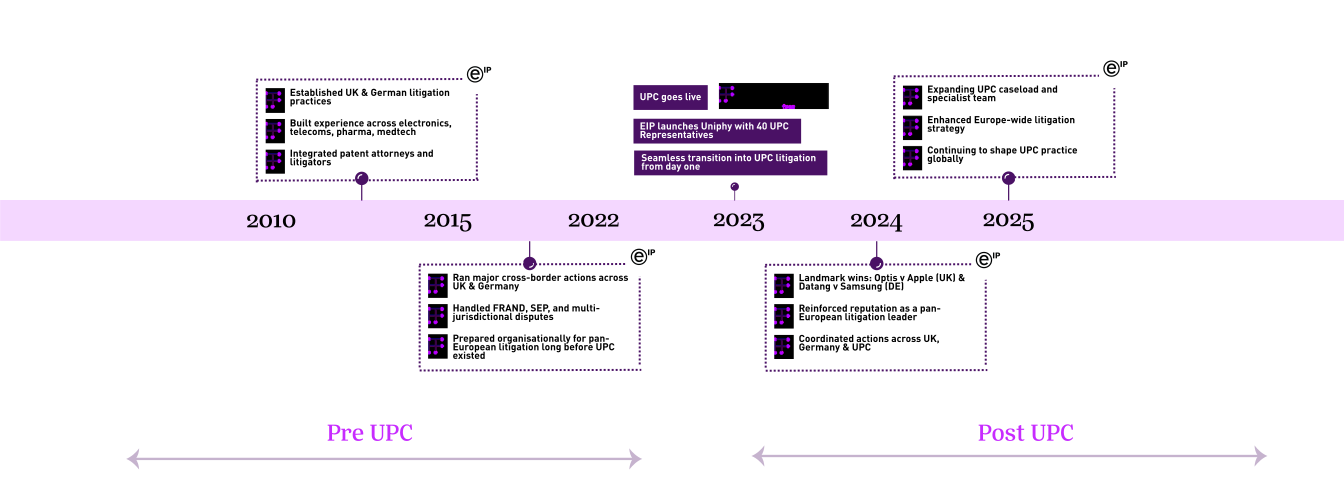
Since its establishment in 2011, our patent litigation team has been dedicated to delivering exceptional results.

With the UPC's launch announced in 2023, our patent litigators have been actively advising on various high-profile UPC proceedings, and appearing in UPC divisions across Europe.

German and UK litigators

Since 2014 our German patent litigators have handled major German national cases and, more recently, in leading cases at the UPC. EIP was successful in the first UPC anti-anti suit injunction, gained on behalf of our client.

The UK can be decisive when devising a litigation strategy in Europe.  With the success of our team of UK litigators, we are routinely trusted with high value cases including those at the highest Supreme Court of the UK.  We are well placed to advise on using the UK courts and/or the UPC’s “long arm” jurisdiction.

Patent attorneys doing litigation

Patent attorneys add unique value to litigation and enhance our results. 

This is especially so for the UPC because all patents litigated at the UPC have been granted by the European Patent Office (EPO) and so are governed by a unique blend of UPC and EPO case law which needs intricate knowledge.

Moreover, where possible the same patent attorney will have drafted and strategically prosecuted the case in suit, and can run any parallel EPO opposition proceedings, bringing deep technical continuity to the litigation.

UPC strategy

The UPC presents unique challenges compared with national patent litigation.  The streamlined timeline from service to decision is short, around 12 months, and the judges are given limited time to work on a case. The court sets tight deadlines to prepare and file each round of written briefs. A UPC action needs deep technical analysis upfront; to develop the winning strategy and present the best arguments.

Often the UPC case is part of a multi-dimensional portfolio.  Our patent attorneys strategically prosecute patent applications and develop portfolios, working closely with our litigators, to secure claims ready for assertion and robust to challenge at the UPC.

Mixed practice growth and litigation highlights
Meet our Head of Knowledge

The UPC is still new by established court standards, and the body of case law is still evolving. Well before the UPC launched, our Head of Knowledge championed the UPC laws and processes, and he has continued to closely follow all the evolving case law.

Darren is a European patent attorney with decades of contentious experience at the EPO, and is an honorary professor at Queen Mary University of London, teaching IP law.

Darren Smyth
Partner, UK and European Patent Attorney, Design Attorney, UPC Representative
Speak to an expert

Meet our UPC team

Our team includes leading Attorneys-at-Law in Germany, technically skilled European patent attorneys, and highly reputed UK solicitors with experience in some of the largest European patent cases. With specialists based in Germany, Sweden (home to the UPC’s only regional division), and the UK (Europe’s largest litigation venue outside the UPC), we field formidable teams tailored to each case.

Our attorneys have worked together successfully for many years, enabling us to respond quickly and intelligently under the UPC’s tight timelines and new procedures. We offer clients a single point of contact for co-ordinated, cross-border litigation support.


Christof Höhne
Partner, Rechtsanwalt, UPC Representative
Jerome Spaargaren
Partner, UK and European Patent Attorney, UPC Representative
Matthew Blaseby
Partner, UK and European Patent Attorney, UPC Representative
Michael Nielsen
Partner, UK and European Patent Attorney, UPC Representative
Monika Rai
Partner, UK and European Patent Attorney, Solicitor, UPC Representative
Isabelle Schaller
Partner, Rechtsanwältin, UPC Representative
Sebastian Fuchs
Partner, Rechtsanwalt, UPC Representative
Gareth Probert
Partner, UK and European Patent Attorney, UPC Representative
Heather McCann
Partner, UK and European Patent Attorney, UPC Representative
James Seymour
Partner, UK and European Patent Attorney, UPC Representative
Catherine Howell
Partner, Solicitor
Joanne Welch
Managing Associate, Patent Attorney Litigator, UPC Representative

Discover our featured insights

Stay informed with the latest UPC developments and the global IP landscape. Tune into our EIP Talks podcast, explore expert insights and browse our published articles and thought leadership, all designed to keep you ahead in the world of intellectual property.

UPC Infringement Actions: Is Speed Meeting Expectations?
23 September 2025
The Unified Patent Court promised simplified and faster patent litigation across Europe. Two years in, we look at whether it’s delivering on that promise. For patent holders and defendants alike, the duration of infringement actions can significantly impact market strategies, investment decisions, and competitive positioning. In this article, we set out an in-depth analysis of how the court’s procedural rules are shaping the pace of litigation. By examining key milestones—from the filing of an infringement action to the issuance of a final judgment—we assess whether the UPC is delivering on its promise of efficiency.
UPC Considers but does not decide exhaustion of rights in relation to consumables
30 October 2025
Brita v. Aquashield UPC CFI 248/2024 (Munich LD), decision of 22 August 2025[1] UPC CFI 564/2024 (Munich LD), decision of 16 October 2025[2] Brita sued Aquashield and others for infringement of...
Beyond Borders: A Backpacker’s Take on Why Your Patent Strategy Needs a Global Mindset
29 September 2025
In today’s interconnected world, innovation rarely stops at borders. Whether you’re a multinational corporation or a UK-based business with global ambitions, your patent strategy should reflect the reality that your products, services, and competitors operate internationally. Much like a well-travelled backpacker planning a round-the-world adventure, businesses must prepare carefully—mapping out routes, anticipating local rules, and packing what’s essential—to ensure a smooth journey.

The latest from the Newsroom on UPC

Transfer of costs application from Court of Appeal to Court of First Instance rejected
22 April 2026
The UPC Court of Appeal ruled that it lacks jurisdiction to assess costs applications and confirmed they must be filed at the Court of First Instance, rejecting a transfer request in Rematec v Europe Forestry.
Revocation of an independent claim does not automatically affect the validity of unchallenged dependent claims
21 April 2026
In Emporia v Seoul Viosys, the UPC Central Division confirmed that the revocation of an independent claim does not automatically affect the validity of unchallenged claims. The decision underscores the importance of challenging all relevant claims where full patent revocation is sought.
Seriously deficient disclosure process not sufficient to reopen costs order - Cabo v MGA
08 April 2026
A High Court decision highlighting the consequences of inadequate disclosure searches under PD57AD and reaffirming that costs orders are final, even where later failures come to light.
UPC Court of appeal issues final decision, despite no finding on infringement at first instance
30 March 2026
In Rematec v Europe Forestry, the UPC Court of Appeal overturned the Mannheim Local Division’s revocation of the patent and, applying Article 75(1) UPCA, issued a final decision on both validity and infringement despite no infringement finding at first instance. The Court adopted a narrower, description‑led approach to claim interpretation, confirmed the patent’s validity, found infringement, and granted final remedies without referring the case back to the Court of First Instance.
Litigation insurance as security for costs
30 March 2026
In Syntorr v Arthrex, the UPC Court of Appeal clarified that while litigation insurance is not itself a form of security under Rule 158 RoP, it is a relevant factor when deciding whether security for costs should be ordered at all. By failing to consider the claimant’s insurance policy, the Munich Local Division wrongly exercised its discretion. The Court set aside the €2 million security order and confirmed that insurance can mitigate concerns about cost recoverability.
National law applies to claims for loss of profit if the events occurred before the UPC came into force
30 March 2026
In Fives v REEL, the Hamburg Local Division of the UPC dismissed a standalone damages action despite prior findings of infringement. Although the UPC was competent to assess damages, the court held that national law applied because the relevant events pre‑dated the UPC’s entry into force. Applying German law, the court found that the claimant had not proven causation or lost profit, highlighting the demanding evidentiary burden for price‑reduction damages claims and the importance of substantiating counterfactual tender outcomes.
UPC’s first referral to CJEU
29 March 2026
In Dyson v Dreame, the UPC Court of Appeal issued its first preliminary reference to the Court of Justice of the European Union. The referral concerns the scope of UPC jurisdiction where a non‑EU manufacturer is sued alongside an EU‑based intermediary acting as an authorised representative, and whether provisional measures may extend to non‑UPC states such as Spain. The decision places important questions about anchor defendants, intermediaries and the UPC’s long‑arm jurisdiction before the CJEU.
LD Paris interprets broadly need for “commercial relationship” and “same alleged infringement” in Art 33(1)(b)
27 March 2026
In Valeo v Bosch, the Paris Local Division rejected a jurisdictional challenge and confirmed a broad interpretation of Article 33(1)(b) UPCA. The court held that defendants belonging to the same corporate group may be sued together at the local division where one subsidiary is established, without requiring a direct commercial relationship between each defendant and the anchor defendant. It also confirmed that “the same alleged infringement” requires only identity of the infringed patent, even where the disputed products are not strictly identical.
Litigants in person and IP risk: Lessons from Banham v Rogers
26 March 2026
The High Court’s judgment in Banham v Rogers provides a stark warning for SMEs defending intellectual property claims without professional advice. Acting as a litigant in person, the defendant misunderstood key technical issues, failed to comply with procedural requirements, and mismanaged correspondence and evidence. These cumulative errors left the court with no realistic defence to consider, leading to summary judgment and public reputational damage. The case underlines the importance of obtaining specialist IP advice at an early stage to avoid avoidable and compounding litigation risks.

Contact us

We’d love to hear from you. Whether you're exploring ways to protect, manage or maximise the value of your intellectual property, we are here to provide tailored support and strategic insight.

Please complete the form below and we will be in touch shortly.

Thank you! Your submission has been received!
Oops! Something went wrong while submitting the form. Please try again.