Exploring IP in a Space Sector Product

Introduction
Innovative space sector businesses generate IP all the time. But it can be difficult to appreciate the range of IP being generated, or the value of that IP.
In order to help illustrate, we've come up with a space sector product of our own*. We'll use this product as the basis of a worked example, to show the range of IP that could potentially be protected, and the value that this could provide.
*This is not a real product. The idea was inspired by this NASA document on State-of-the-Art of Small Spacecraft Technology, published 12 February 2024. The imaginary product is for the purposes of illustrating example IP issues only, and it is not intended to relate to any existing (or future) actual product.
Technological background to the product
The linked NASA document explains that the two main modes of communication between ground terminals and satellites are FSO (Free Space Optics) and RF (radio frequency). This is because the atmosphere and the ionosphere together are opaque in other parts of the electromagnetic spectrum.
As the document states, there are advantages and disadvantages to each of FSO and RF. However, wouldn't it be useful to have a communications terminal with the advantages of both?
The product
The (imaginary) product is a communications terminal that combines both FSO and RF transceivers, and which has a controller that controls whether FSO, RF or both are used in communications, so that at any given time, the most appropriate mode is used.
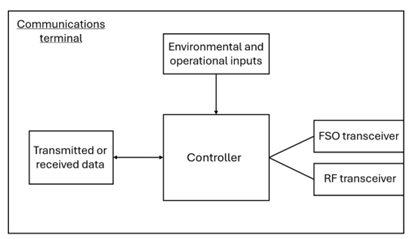
The control is based on multiple input measurements representing the current environmental and/or operational conditions. Example measurements include:
- the data rate needs (FSO allows a higher data rate so may be preferable when high data rate applications are in use, or both FSO and RF may be used together to maximise data rate);
- the weather conditions in the communications path (FSO is more affected by cloud cover so in this case it may be better to use RF).
These measurements are input to a control algorithm, implemented in software, which outputs a determination of whether RF or FSO or both should be used for the current conditions. For example, the algorithm might involve a look-up in a database storing empirically derived mappings of conditions onto communication modes. A controller controls the terminal to use RF and/or FSO based on the output of the algorithm.
The control may be performed by either the ground station terminal or the satellite terminal. The control result determined by one terminal may be communicated to and used by the other terminal. It is also conceivable that the control may be performed by another entity (such as a datacentre at which the algorithm is executed) in communication with the ground station and/or the satellite terminal.
Exploring IP
Possible IP in the product
Possible IP in the product might include (among others):
- patentable inventions in the control technique and the terminals;
- copyright in the code for executing the control;
- possible database rights in the database.
Protecting the IP
The product and/or control technique could in principle be protected using Trade Secrets or Patents.
A trade secret is confidential know-how or other information that is valuable to a business because it is secret, and for which reasonable steps have been taken to keep the information secret. If someone obtains a trade secret without the owner's permission, then remedies can be sought in court, such as an injunction and damages.
A patent is a time-limited (up to 20 years) right to prevent others from using the owner's (new and non-obvious) invention in a given territory. A patent would be obtained by filing and prosecuting to grant a patent application for the invention. Not all software is patentable. However, we believe the present control technique would be considered patentable (e.g. at the European Patent office and the UK IPO) as it controls a technical process.
In contrast, it may not be possible to rely on trade secrets to protect the control technique. For example, if the control is performed at a ground station, which may be sold unconditionally or otherwise available to the public, then trade secret protection may not be available as it may not be possible to keep the control process a secret.
Further, patent protection could offer stronger protection for the control technique than trade secret protection, as it would provide protection even where information about the process is later publicly leaked or disclosed, and even where someone else later comes up with the same idea independently. (For a more detailed comparison of Trade Secrets vs. Patents in the UK space sector, please see our related article here).
It would therefore be worthwhile to consider applying for patent protection for the control technique invention (assuming of course that the control technique had not yet been publicly disclosed).
The copyright in the code for executing the control process exists automatically (provided the code is original). Copyright allows the owner to prevent others from copying or distributing the code (or adaptations of the code) without permission.
Similarly, a database right in the database may exist automatically (provided there has been sufficient investment in obtaining, verifying or presenting the data). Unlike copyright, the data does not have to be original. The database right allows the owner to prevent others from extracting data from, or otherwise reutilizing, a qualifying database.
The value in the IP
Patenting the control process would provide a right to prevent others from performing the same invention (even if they later come up with the same idea independently), which would give a significant competitive edge.
Alternatively, the patent rights could be sold or licensed to others, which may generate significant revenue streams. Further, the patent (or patent application) would be valuable tool for attracting investment and for marketing the innovation.
The copyright in the code could be licensed to others to use. This could provide an additional source of revenue. Alternatively, the code could be released under an open source software license, which might promote others to adopt the control protocol, which may in turn improve uptake (and hence sales) of the product.
Similarly, the database right can be licensed for others to use the database. This may offer a means by which the investment in obtaining the empirical data can be monetized.
What and where to patent
A patent application for this product might include claims covering the control method, the terminal, the system of the ground station and satellite terminals (as well as other control entities); and a computer program that performs the control method. This would allow patent protection to be pursued for a wide range of aspects of the product.
Regarding where (i.e. in which jurisdictions) to apply for patent protection, the method may be performed by a ground station, a satellite, or possibly another entity (such as a datacentre executing the control algorithm). For space objects such as a satellite in space, the relevant jurisdiction is the state where the space object is registered for launch (for more detail on this, see the ‘patent' section of our related article here). Accordingly, it would be prudent to consider applying for patent protection in the main jurisdictions where the ground station will be manufactured, sold, or used; where the satellite will be manufactured or registered for launch; and/or where the control algorithm is likely to be executed.
It is noted that the new European patent with unitary effect (the so called unitary patent) can provide uniform patent protection in multiple EU member states (currently 18 at the time of writing). Accordingly, an example patent strategy for this product might be to file a patent application in Europe (at the European Patent Office) and the US (at the US Patent and Trademark Office). If granted, these would together provide wide coverage across Europe and the US.
Other IP considerations
It might be that the control algorithm is implemented using (someone else's) open source code. In that case, it would be important to make sure that the obligations of the open source licence(s) under which the code is provided are identified, understood, and complied with. If this is not done, then this opens the risk of copyright (and possibly also patent) infringement.
Further, it may be that aspects of the product or control process are covered by someone else's existing patents. It is generally advisable to perform a Freedom to Operate search for patents covering the product in relevant jurisdictions, in order to be better informed of the potential infringement risks that may exist. Further, it is generally better to know about infringement risks and manage them in advance, if possible, in order to avoid surprise "cease and desist" letters after the product operation and marketing is already in full swing.
Conclusion
As we've seen in this worked example, a space sector product can involve various forms of IP. Protecting this IP can provide not only a competitive advantage, but value in other forms, such as opening up additional revenue streams, attracting investment, and promoting uptake. An effective IP strategy will look to maximise the value in the IP, to help provide the best possible outcomes for the business. If you would like to discuss protecting IP in your product, or ways of optimising your IP strategy, do feel free to get in contact.
The Latest Thought Leadership pieces in the Content Hub

The Patent Strategist
Get expert insights and the top patent stories delivered straight to your inbox.